

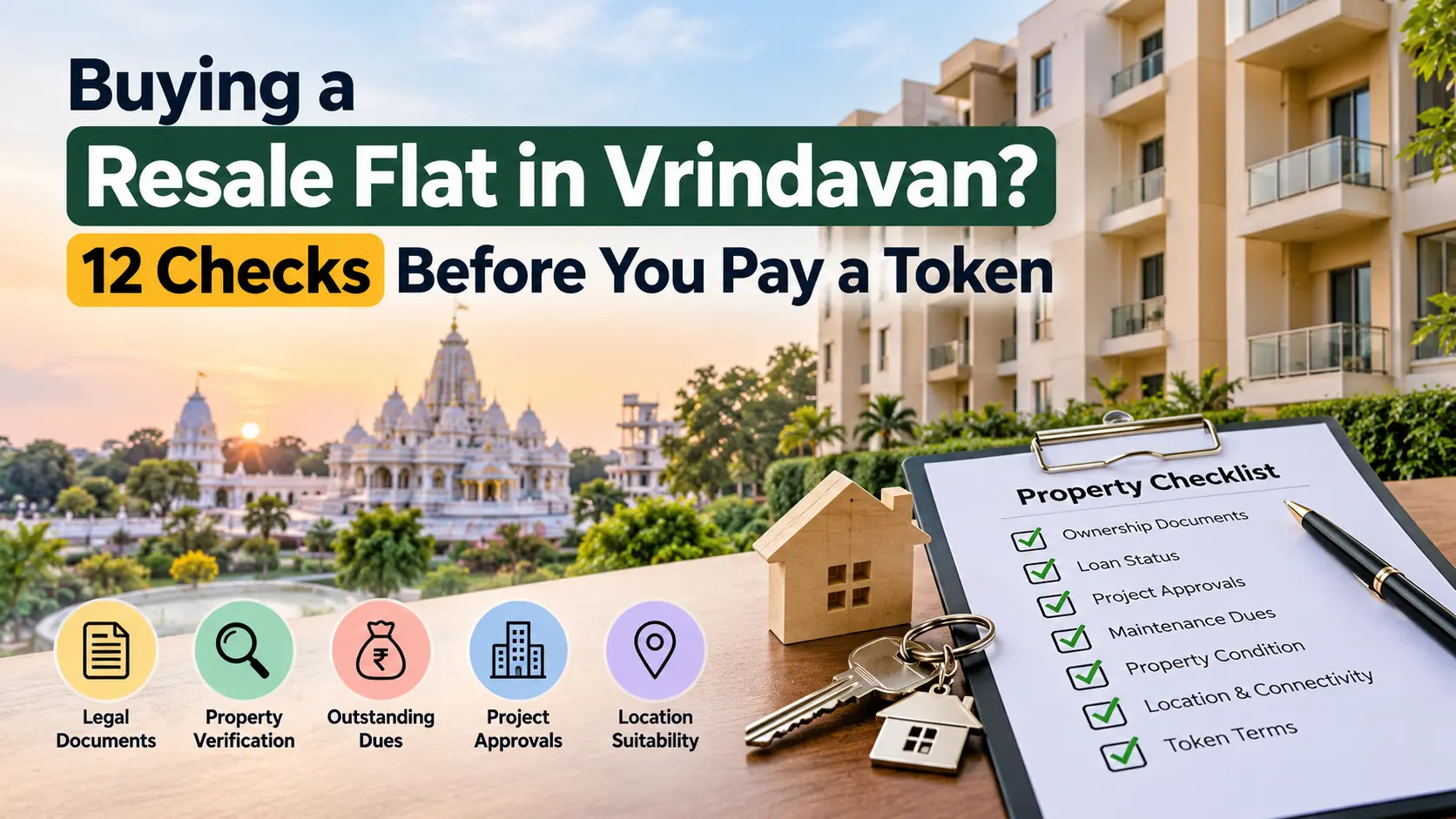
Found a resale flat in Vrindavan that looks right for your budget?
Before you transfer token money, stop and verify the property properly.
Resale flats in Vrindavan can be a good option for buyers who want to inspect the actual property, building condition and location before making a purchase. But before you pay token money, it is important to verify the seller, ownership documents, outstanding dues and property details carefully.
But buyers can still face problems if they focus only on the price, location or furnishing and leave documentation checks until after paying the token.
Whether you are looking at a flat in Rukmani Vihar, around Chhatikara Road, Sunrakh Road, Chaitanya Vihar, Omaxe Eternity or another part of Vrindavan, the basic rule remains the same:
Verify the seller, verify the property and understand the token conditions before committing your money.
Here are 12 important checks to complete before buying a resale flat in Vrindavan.
Quick Checklist Before Paying Token Money
| What to Check | What You Need to Confirm |
|---|---|
| Seller identity | Is the person legally authorised to sell? |
| Ownership documents | Does the seller have clear ownership? |
| Existing loan | Is any bank loan or mortgage pending? |
| Project details | What do available official project records show? |
| Property approvals | Does the property match available approved records? |
| Completion documents | Are applicable completion or occupancy documents available? |
| Flat details | What exact area, parking and fixtures are included? |
| Outstanding dues | Are maintenance, electricity and other dues cleared? |
| Transfer process | Are any society/project transfer formalities required? |
| Physical condition | Does the flat need major repairs? |
| Location suitability | Does the property suit your actual use? |
| Token terms | What happens if verification fails? |
1. Confirm Who Actually Owns the Flat
Your first check should be the seller, not the price.
Ask to see documents showing who legally owns the property.
The name on the ownership documents should match the person selling the flat.
If the property has joint owners, all relevant owners may need to participate in the transaction.
Extra caution is required where the property involves:
- joint ownership;
- inherited property;
- Power of Attorney;
- a legal representative;
- a family member handling the transaction;
- an authorised representative instead of the registered owner.
Do not rely only on a broker or seller saying, “Documents bilkul clear hain.”
For a high-value transaction, the ownership structure should be independently reviewed by a qualified property lawyer.
2. Check the Ownership and Title Chain
A copy of the latest sale deed alone may not always be enough to understand the property’s history.
Ask for the relevant ownership documents that show how the property reached the current seller.
Important details should remain consistent across documents, including:
- owner’s name;
- project name;
- flat or unit number;
- floor;
- property description;
- area details where recorded.
The purpose is to identify whether there is a clear and understandable ownership chain.
If names, flat numbers or property descriptions do not match, get the discrepancy explained and verified before proceeding.
This is especially important when buying an older resale flat where the property may already have changed ownership more than once.
3. Check Whether the Flat Has an Existing Home Loan
A resale flat may still have an active home loan.
That does not automatically mean you should reject the property.
However, you need to understand how that loan will be closed and how the lender’s charge over the property will be released.
Ask:
- Which bank or financial institution has financed the property?
- Is any amount still outstanding?
- Which original property documents are with the lender?
- How will the existing loan be closed?
- At what stage will the bank release the original documents?
- What NOC or loan-closure documentation will be provided?
Do not rely on statements such as:
“Registry ke time loan close ho jayega.”
The payment and loan-closure sequence should be clear before you pay a substantial amount.
If you are taking your own home loan to purchase the property, your lender may also carry out legal and technical checks.
4. Check the Project on UP RERA Where Applicable
If the project falls within the scope of UP RERA records, search for the project on the official UP RERA portal.
Check available information relating to the project and promoter rather than depending only on screenshots or registration details forwarded by someone else.
However, remember one important point:
A project’s RERA status and an individual resale flat’s title are two different things.
Finding the project on UP RERA does not automatically prove that:
- the current seller owns the flat;
- the flat has no pending home loan;
- the seller has cleared all dues;
- the individual unit has no title-related issue.
RERA verification should therefore be treated as one part of your overall property due diligence.
5. Check Property Approvals and Relevant Completion Documents
For a completed apartment, ask what approvals and completion-related documents apply to the building or project.
Where relevant, check information available through authorities such as the Mathura-Vrindavan Development Authority.
Buyers should not assume that the words “ready to move” automatically mean every required approval is in place.
Depending on the property, relevant documents may include:
- sanctioned or approved building plans;
- completion-related documentation;
- occupancy-related documentation where applicable;
- other authority or project records relevant to the property.
The requirements can vary depending on the project and type of development.
If you are unsure whether a particular document is applicable to the flat you are buying, take professional legal advice rather than making an assumption.
6. Confirm Exactly What Is Included in the Deal
A common resale mistake is negotiating a total price before clearly defining what is being sold.
Before paying the token, confirm the exact:
- flat number;
- floor;
- area being quoted;
- parking arrangement;
- furniture included;
- appliances included;
- fixtures included;
- storage rights, if any;
- balcony or terrace rights, if specifically claimed;
- possession condition.
Also understand whether the seller is quoting:
- carpet area;
- built-up area;
- super built-up area.
These measurements are not interchangeable.
A furnished resale flat may appear more expensive because furniture, air conditioners or appliances are included.
Make sure both parties understand exactly what stays in the property after possession.
7. Check Maintenance and Other Outstanding Dues
Outstanding dues can become an unpleasant surprise after the buyer has already committed to the deal.
Before token or at least before making any major non-refundable payment, ask the seller for the current status of applicable:
- maintenance charges;
- society or association dues;
- electricity bills;
- water bills;
- property tax where applicable;
- other project-specific charges.
Do not settle for:
“Sab clear hai.”
Ask for supporting documents or receipts wherever reasonably possible.
Also confirm who will clear any dues arising up to the date of possession or registration.
8. Understand the Project or Society Transfer Process
Some apartment projects or residential associations have their own resale-transfer procedure.
Ask whether any of the following is required:
- transfer application;
- society or association NOC;
- developer confirmation;
- transfer fee;
- maintenance clearance;
- buyer KYC;
- seller clearance;
- updated ownership records after registration.
You should understand these requirements before finalising the total transaction cost.
Otherwise, buyer and seller may later disagree about who is responsible for additional transfer-related expenses.
9. Inspect the Actual Condition of the Flat
One of the biggest benefits of buying resale property is that you can inspect the actual asset.
Do not judge the flat only through listing photographs.
Check for visible issues such as:
- seepage;
- damp walls;
- damaged flooring;
- plumbing problems;
- drainage issues;
- electrical condition;
- door and window condition;
- water pressure;
- bathroom condition;
- balcony condition;
- lift condition;
- common-area maintenance;
- power backup, where available;
- parking accessibility.
A newly painted flat can still have underlying moisture or repair issues.
If you notice major cracks, persistent dampness or another serious technical concern, consider getting the property checked by a qualified professional before proceeding.
10. Evaluate the Vrindavan Location for Your Actual Requirement
A flat should not be selected only because the listing says:
“Near Prem Mandir”
or
“Prime Vrindavan location.”
Different buyers have different priorities.
For a second-home buyer
You may care more about:
- access to temples;
- peaceful surroundings;
- parking;
- building maintenance;
- security;
- ease of staying occasionally.
For an end-user
You may give more importance to:
- daily accessibility;
- grocery and essential services;
- parking;
- road access;
- long-term residential environment;
- society occupancy.
For an investor
Your evaluation may also include:
- property-management requirements;
- ongoing maintenance;
- tenant suitability;
- building condition;
- resale liquidity;
- ease of managing the property while living outside Vrindavan.
Areas such as Rukmani Vihar can offer a different environment from properties around Sunrakh Road or Chhatikara Road.
Rather than deciding only from Google Maps or an online listing, personally inspect the location.
Where possible, visit at different times so you understand access, traffic and the surrounding environment better.
11. Compare the Asking Price Properly
Property portal prices are usually asking prices.
They are not necessarily the final transaction price.
Two 1 BHK flats in Vrindavan may have completely different values because of differences in:
- project;
- exact location;
- floor;
- area;
- age of construction;
- furnishing;
- condition;
- parking;
- maintenance;
- society condition;
- seller’s commercial expectations.
When comparing resale flats, create a simple comparison sheet.
Record:
Project / Locality
BHK
Area
Area type
Floor
Parking
Furnishing
Property condition
Quoted price
Pending charges
Major advantages
Major limitations
This will help you compare properties on a like-for-like basis instead of choosing the cheapest advertisement.
Also remember that:
asking price, negotiated transaction value and government/circle-rate-related values are not the same thing.
They should not be mixed together when evaluating a property.
12. Read the Token Terms Before Paying
Token money should not be treated casually.
Before making the payment, ensure the buyer and seller clearly understand what the token represents.
The written token receipt or agreement should clearly identify:
- buyer;
- seller;
- property;
- token amount;
- payment method;
- agreed property price;
- major commercial terms;
- payment timeline;
- registration timeline where agreed;
- inclusions, if relevant.
Most importantly, understand what happens if:
- ownership verification reveals a serious problem;
- the seller cannot provide required documents;
- an undisclosed loan or charge is discovered;
- major outstanding dues are found;
- legal verification fails;
- the seller backs out;
- the buyer backs out;
- agreed conditions are not fulfilled.
Do not assume that token money is automatically refundable.
Do not assume that it is automatically non-refundable either.
The written terms and circumstances of the transaction matter.
If the token amount is significant, have the document reviewed by an appropriate legal professional before signing.
Avoid transferring undocumented cash simply because somebody says:
“Sir, dusra buyer ready hai. Abhi token kar do.”
A genuine opportunity still needs proper documentation.
Red Flags Before Buying a Resale Flat
Slow the transaction down if you notice any of these warning signs:
- seller refuses to share ownership papers;
- seller’s name does not match the documents;
- unexplained differences exist in flat numbers or property details;
- original documents are unavailable without a clear reason;
- an existing loan is disclosed late;
- seller refuses to provide information about dues;
- physical construction differs materially from the property records;
- unexplained transfer charges suddenly appear;
- seller insists on immediate token payment before verification;
- only cash payment is being encouraged;
- verbal promises are not being put in writing.
A low asking price does not make unclear ownership acceptable.
A premium Vrindavan location does not compensate for problematic paperwork.
Questions to Ask the Seller Before Paying Token
Before committing money, ask the seller these questions directly:
- Who is the registered owner of the flat?
- Are there any joint owners?
- Is there an active home loan?
- Where are the original property documents?
- Are all maintenance and utility dues cleared?
- What exact area is being quoted?
- Is parking included?
- Which furniture and fixtures are included?
- Is any society or project transfer process required?
- When will vacant possession be given?
- Are there any pending disputes relating to the property?
- What happens to the token if document verification reveals a material problem?
If these questions cannot be answered clearly, the transaction may not yet be ready for your money.
Should You Buy a Resale Flat in Vrindavan?
A resale flat can make sense for buyers who prefer to inspect the actual property before making a decision.
You can evaluate:
- the exact unit;
- actual building condition;
- neighbourhood;
- access;
- occupancy;
- maintenance;
- parking;
- surrounding development.
But the decision should not be based only on appearance or price.
Before buying, separate your decision into three questions:
1. Is the seller legally entitled to sell this flat?
Verify ownership and authority.
2. Are the property and transaction documents satisfactory?
Check the title, outstanding loan, dues, project details and other applicable records.
3. Does the flat actually suit your requirement?
Evaluate location, condition, budget, maintenance and intended use.
Only once these three questions are satisfactorily answered should you move toward final negotiation and token payment.
Need Help Comparing Resale Flats in Vrindavan?
If you have shortlisted a resale flat but want to compare it with other available flats in Vrindavan, Radhika Estates can help you identify suitable options based on your budget, preferred locality and intended use.
You can compare properties first, arrange a site visit and then proceed with independent legal/document verification before committing your funds.
Explore suitable property in Vrindavan with Radhika Estates and make the decision only after you understand exactly what you are buying.
Frequently Asked Questions
Is it safe to buy a resale flat in Vrindavan?
Buying a resale flat can be safe when the seller’s ownership, title documents, outstanding loan, applicable approvals, dues and physical property condition have been properly checked. The safety of the transaction depends on the individual property rather than simply the project’s name or locality.
Should I pay token money before checking the property documents?
Basic ownership and property-document checks should ideally be completed before making a substantial token payment. If further verification remains pending, the written token terms should clearly explain what happens if a material legal or documentation issue is later discovered.
Is UP RERA registration enough when buying a resale flat?
No. RERA information can help with project-level verification where applicable, but resale buyers still need to verify the current seller’s ownership, individual flat documents, existing loan or mortgage and outstanding dues.
What documents should I ask for when buying a resale flat?
Depending on the property, you may need to review the seller’s registered ownership documents, relevant title-chain records, identity documents, loan-related papers where applicable, applicable project/building documents, maintenance and utility records and transfer-related documentation. A property lawyer can advise which documents are required for the particular transaction.
Can I buy a resale flat that still has a home loan?
It may be possible, but you need a clear process for repayment of the seller’s outstanding loan and release of the lender’s charge and original documents. Your bank and legal adviser should review the transaction structure where applicable.
Is a resale flat near Prem Mandir automatically a good investment?
No. Proximity to Prem Mandir may be useful for some buyers, but the property’s price, condition, access, parking, maintenance, documents and suitability for your intended use are equally important.
Should I hire a lawyer before buying resale property?
For a significant property transaction, independent legal verification can help you understand title, ownership, mortgages, transaction documents and other legal issues before you commit substantial funds.
